
Invisible Strings

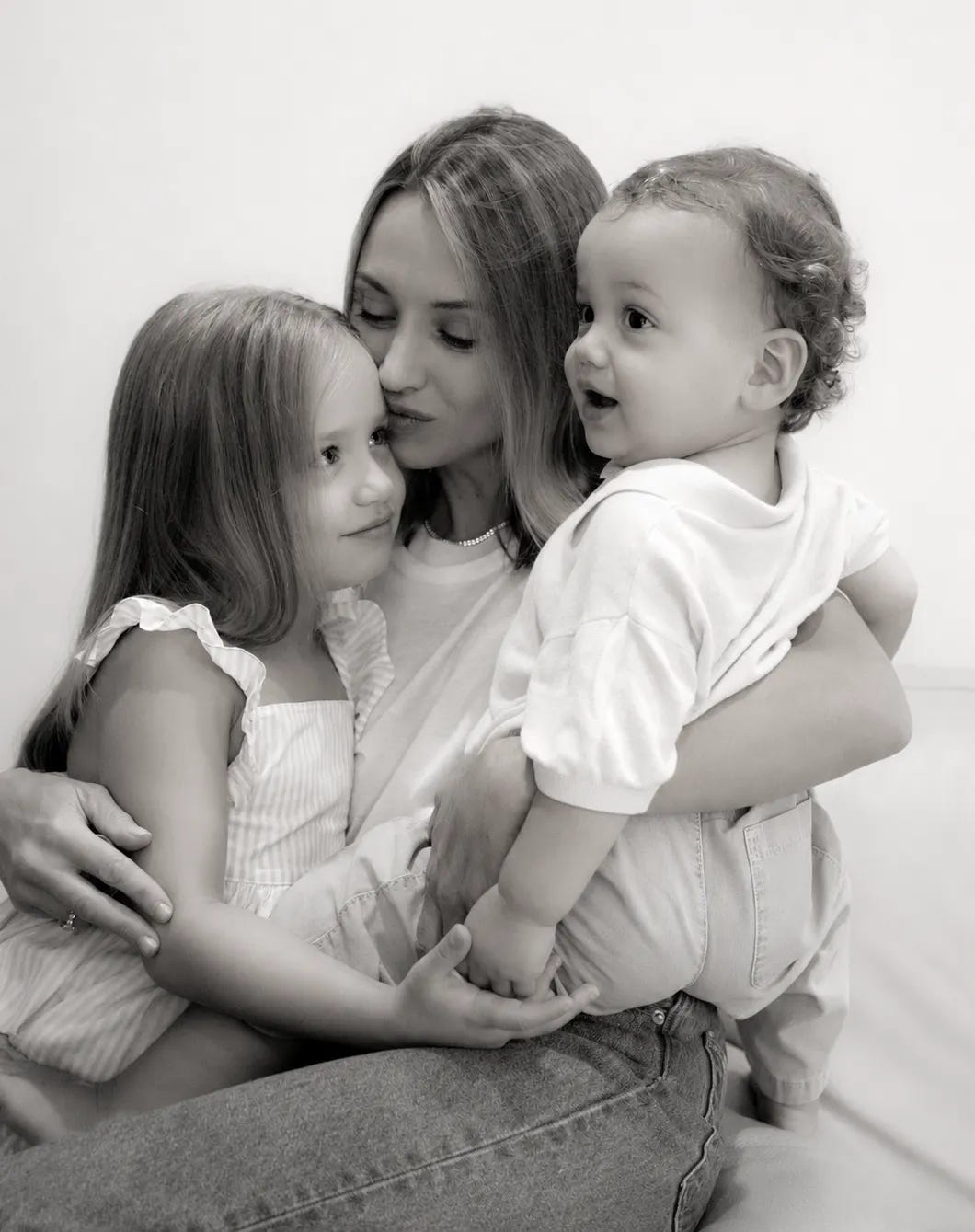
A few weeks ago, I found myself standing in the corner at my nephew’s 30th birthday party at a Soho clubstaurant, my eyes fixed on my phone. My parents had just left with my overstimulated, hysterical daughter, and I was tracking their Uber between sips of Sancerre to ensure they got home in one piece. At some point, I realized that the wine was no longer a good idea, for the human alarm that is my sixteen-month-old son would have me up at 6:30 a.m., and each late-night sip would only intensify the impending headache.
At the same time that I was going through said cerebral buzzkill, my partner and father of my two children was next to me, reposado glass in hand, bobbing away to the sounds of music I’m too old to recognize, having the time of his life. His mind was already far away from the Uber carrying our frenzied daughter, and certainly nowhere near the wake-up routine of our sleeping son.
This is in no way a criticism of Dave, who is an engaged and committed father, nor is it a commentary on men in general. (Let’s save that for a separate post!) Rather, the moment illuminated something that almost every mother I know experiences as part of her everyday reality. It is a sense of responsibility, an interconnectedness, an enmeshment that makes us incapable of ever fully separating from our children, no matter how much we may occasionally like to.
Part of that feeling undoubtedly stems from the invisible labor that, in most families, still falls on the mother, who remains responsible for the management of all the minute details of her children’s lives. In today’s child-centric parenting world, it is so all-consuming that, at times, it starts bordering on obsession—an inability to stop and sit still amid the schedule monitoring, grocery orders, field trip waivers, and next elaborate birthday production rat race.
And yet I don’t think that’s the whole story, because there’s something far more intrinsic that makes detaching from our kids so difficult. Even when the logistics are sorted and I’m away from my children (which is relatively often), there’s always an invisible string linking me back to them, my mind drifting to what they’re doing, how they’re feeling, and whether my absence might somehow affect them. In a way, there’s no longer a version of me that exists entirely on her own—someone who can stay out late, write without looking at the clock, and act out every other selfish desire without considering the domino effect. Sometimes it feels as though the proverbial umbilical cord was never properly snipped, that there is no more me without my children.
I recognize that much of this is a function of early parenting, for I have a toddler who requires full time care and an abundance of human connection merely to stay alive. I can already see how much easier it is to let go of my five-year-old, as her world rapidly expands beyond us. And yet, as kids get older, one set of worries simply gives way to another. Next comes the era of mean kids and bullies, followed by teen dramas and bad influences, and waiting around in the evenings, wondering who they’re with and whether they’re making the right decisions.
Even when children become adults and leave the home, mothers don’t always let go. I see how involved my mom still is in my life, and not just by way of being an engaged grandmother. (Which, ironically, is the only time I can fully relax and let go of my own kids.) She’s attuned to every sinus infection, bout of insomnia, and personal melodrama; sometimes it feels as though she experiences them in her own body almost as much as I do. As the saying goes, you’re only ever as happy as your least happy child.
It’s a beautiful burden to carry, one that has given me a purpose I never knew existed and that I wouldn’t trade for the world. It comes with so much love and such a profound expansion of the self, an ability to rise above exhaustion, fear, and discomfort in service of the humans we created. Motherhood transforms us from girls into women: brave, expansive, selfless, capable of doing extraordinary things for the people we love most.
And yet, when it comes to true self-understanding, there is an essence in each person that needs to exist independently. For me, this core self has become increasingly difficult to tap into. Every attempt at meditation somehow turns into a running to-do list, or a gratitude practice rooted in the wellbeing of my kids. I’m so deeply immersed in my little world that I can never fully detach, and I occasionally catch myself wondering who I even am outside of it. Am I still an interesting person? A thinker? A writer? One who is capable of contributing something more meaningful than a thousand-word essay on her own mental turmoil?
The answer can only be found through time and space, neither of which I have much of. Now that the divorce era is officially upon us, I look with fascination at the women who suddenly have full weekends—or even weeks—to get back to their own personhood, to step away from the logistical hamster wheel and go out into the world to live independent lives. It’s fascinating what a woman at her prime (and I will go ahead and call our forties our prime!) can be when given an expanse of time and space to realize herself. Youth is wasted on the young, and yet a return to certain core elements of youth—independence, time, freedom—is rarely wasted.
But I digress, because I don’t actually want this space or independence, nor am I strong enough to handle it. The other night, I couldn’t sleep, the hours stretching into an endless, insomnia-fueled abyss, overrun with fears and dark thoughts and doomsday scenarios that make 3 a.m. the scariest of mental jails. And then my five-year-old stumbled into my room from a bad dream, and suddenly I was a mother again, cuddling her to sleep and drifting off right next to her. Being a mother feels safe. Being alone with my monkey mind is far more daunting.
If you regularly read this Substack, you know that this is a recurring theme—the loss of freedom, the search for identity. I once described motherhood as the sweetest Stockholm syndrome ever known, and I stand by those words even more now. Motherhood holds opposing truths: to feel trapped and grateful, depleted and invigorated, lost and more certain of our purpose than ever before. Somehow, they all coexist. For everything else, there’s Sancerre.
I loved this and feel every word of it! Please know, though, that moms who coparent don’t detach, either. We feel the push-pull of wanting the time to re-discover ourselves and also that pain of being away from our child, and the weekends apart from them are still spent doing things for them.
"I occasionally catch myself wondering who I even am outside of it. Am I still an interesting person? A thinker? A writer? One who is capable of contributing something more meaningful than a thousand-word essay on her own mental turmoil?" SAME, MARINA, SAME. So grateful to read your words that always, without fail, make me feel less alone.